Excellent 4.8 | 310 reviews
Your Trusted North Texas Plumber | Jennings Plumbing Services
Follow Us:
Excellent4.8 | 310 reviews
Your Trusted North Texas Plumber | Jennings Plumbing Services






When you smell gas, hear a hiss, or see a pilot go out — that’s not the time to panic. It’s the time to think clearly and act safely. At Jennings Plumbing Services, we don’t “guess” at gas leaks. We prove them, fix them, and verify safety before the line ever goes live again. Since 2003, our licensed team has handled everything from home cooktops and water heaters to restaurant grills and rooftop units. Whether it’s black iron, CSST, or underground polyethylene, we’ve seen it all — and we know what the code really expects.

Natural gas has no smell by itself — the “rotten egg” odor comes from mercaptan, added for safety.
If you notice that smell, take it seriously.
Other red flags:
What to do:
Gas systems fail for a handful of reasons — and most have nothing to do with luck:
Every gas job starts and ends with one goal: safety.
Step 1 — Isolation
We shut the system down and confirm it’s depressurized before we touch a wrench.
Step 2 — Testing
We pressure-test the line with air or nitrogen — never gas.
This finds even the smallest leaks before the line goes back into service.
Step 3 — Locate & Repair
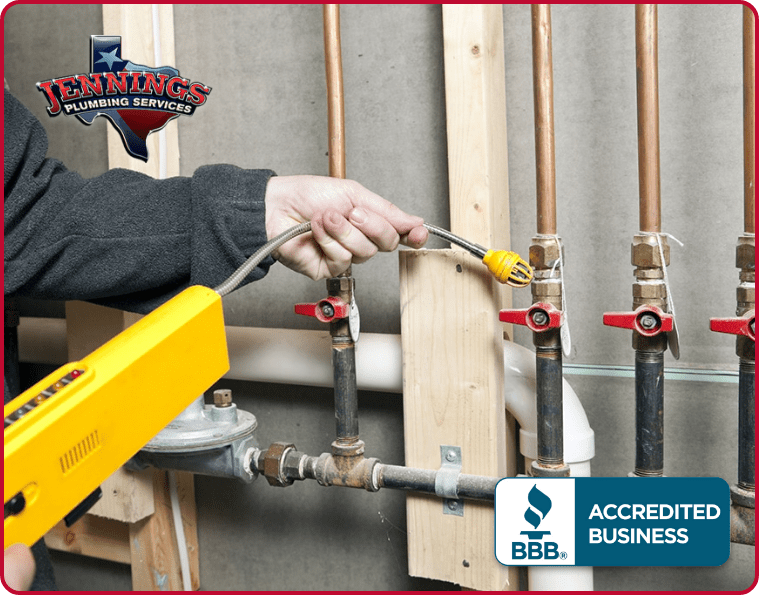
We use detection equipment to pinpoint the issue — not just chase smells. That could mean tightening a joint, replacing a section, or rerunning the entire line.
Step 4 — Inspection & Re-Test
After repair, we retest to code standards.
If it’s a permitted job, we handle the inspection and paperwork from start to finish.
Step 5 — Safety Verification
We relight pilots, check combustion air, and verify proper venting. When we leave, the system isn’t just running — it’s right.
Most cities around North Texas only require a 2.5 psi pressure test, but we usually go a little higher — 3.5 psi from the meter in, all the way through the line.
That’s the only way to prove it’s tight.
We always test from the meter to the last appliance, because that’s the real system. On older homes, this can feel like opening a can of worms — and here’s why.
Those old thread sealants have been sitting for a decade or more, only holding back 4–6 ounces of pressure.
When we bring that system up to 3.5 psi to verify it’s safe, some of those joints can give out.
It’s not us “causing” a leak — it’s the first time that line’s been under real stress since the day it was built.
And when homeowners say, “But I never smelled gas before!”
That’s because at ounces of pressure, a weak joint can hold.
At pounds of pressure, it tells the truth.
That’s why we warn every customer — expect a few issues during testing.
You can talk all day about electronic sniffers and fancy sensors, but nine times out of ten, it still comes down to a spray bottle and a pair of tired eyes.
We hit every joint with soapy water and stare — sometimes for minutes. If a bubble forms, even slow, it’s a leak.
No alarms, no gimmicks. Just patience and experience.
It’s how plumbers have been proving gas joints for over a century.
And yeah — after a while, your eyes start to cross, but that’s what it takes to keep people safe.
In North Texas slab homes, gas lines almost always run through the attic — and that means chasing leaks in the middle of August feels like working inside an oven lined with fiberglass.
In pier-and-beam homes, the story flips — the lines run under the floor, and that means crawling through tight, dusty spaces with critters and damp soil.
Either way, we go where the line goes.
Hot attic, cold crawl, doesn’t matter — we find it, prove it, and make it right.
The very last spots we check are the ones that mean opening sheetrock or brick. We’ll check and double-check every fitting, every run, and every joint before we cut anything open.
If we’re opening a wall, it’s because we’ve proven that’s exactly where the problem is — not a guess, not a gamble.
That’s what separates a real plumber from a parts changer.
Then there’s CSST (Corrugated Stainless Steel Tubing) — the flexible yellow gas line you see in newer builds.
We bring 2 psi of gas into the home, reduce it in the attic through a central manifold, and vent the regulator through the eave per code.
It works, but it’s not my favorite design.
That much pressure overhead, with flexible tubing and lightweight strapping, can lead to long term issues — especially when the bonding isn’t done right.
CSST is fast to install, but like everything else in plumbing, speed isn’t the same as quality.

Under TSBPE Chapter 1301, only a licensed plumber working under a Responsible Master Plumber (RMP) can install, test, or repair gas lines in Texas.
All work follows NFPA 54 (National Fuel Gas Code) and the International Residential Code (IRC) version your city enforces.
That means:
We stay current on every local amendment — and we build above the minimums every time.
Most cities around us follow the IPC (International Plumbing Code) and IRC (International Residential Code) — they just pick which year to adopt.
We track every jurisdiction we work in because code compliance isn’t optional.
But here’s what most plumbers won’t tell you: code is a 70 out of 100.
It’s the bare minimum to pass inspection, not the best way to build.
At Jennings Plumbing, we don’t build to code — we build better than code. That means:
Some inspectors think we’re on crack.
Most homeowners call us back when they need work done right.
Code keeps you legal. Our standards keep you safe.
| Safe Steps | Don’t Do This |
| Shut off the main gas valve if you smell gas. | Spray soapy water on joints with active gas pressure. |
| Call 811 before digging. | Use lighters or matches to “find” leaks. |
| Ventilate the area if it’s safe to do so. | Try tightening fittings without a proper test. |
Gas work isn’t guesswork — it’s precision and patience.
Every material has its place:
We inspect the entire system and upgrade materials when needed for safety and longevity.
In the 1800s, homes ran on “town gas” — made from coal and piped into lamps. When natural gas took over, it was cleaner and safer — but required new materials and new codes.
Today, Texas enforces NFPA 54 and TSBPE licensing for a reason.
Every gas system we touch is tested, tagged, and verified before relight.
No shortcuts, no exceptions.
Gas line pricing depends on:
We don’t quote sight-unseen — too many variables.
Text photos to 972-492-5369 , and we’ll walk you through what drives the cost before we start.

Having an open and clear communication is a top priority. You can rest assure we will always provide clear communication.
Since 2003, we've been happily serving customers like you as a local, family-owned company based in Little Elm, TX.
We always put our customers first and want to ensure your needs are taken care of every time.
We are proud to offer fast, friendly, and affordable plumbing services in Little Elm, guaranteeing you are satisfied.


The plumber treated my home like his own and solved a tough drain problem.

They repaired my water heater in Carrollton and explained everything clearly.
JPS fixed my slab leak in Frisco in a single day.
“This will be the only plumbing company I ever use going forward. Highly Recommend!”
“They did a great job of scheduling and getting repairs done quickly!”
“They worked very hard all day long!”
“Jordan was Amazing!”
“The plumbers are respectful of my home and time.”
“The workmen were very polite and told me everything I needed to know.”
“They are prompt, reliable, and know what they’re doing.”
“They made us feel like they really cared about our situation.”
“Would absolutely recommend!”
“Jennings is the best!”
“That might be the fastest I’ve ever seen a plumber make it out!”
“Will definitely recommend them to others and use them again in the future.”
“He was punctual, quoted a fair price for the work.”
“Will recommend and use them again.”
No. Leave immediately and call 911 or your gas utility.
Yes — licensed plumbers under an RMP can install, test, and repair gas piping in Texas.
Yes, for new installs, additions, or major repairs. We handle the paperwork.
Usually 1–2 hours for most home systems.
Old thread sealants and low-pressure operation hide weaknesses.
When tested properly, they show up — and that’s exactly the point.


Copyright © 2026 Jennings Plumbing Services. All Rights Reserved. Powered by Fast Hippo Media

 972-492-5369
 SCHEDULE APPOINTMENT


